
Portable Charger vs Power Bank: Is There a Difference?
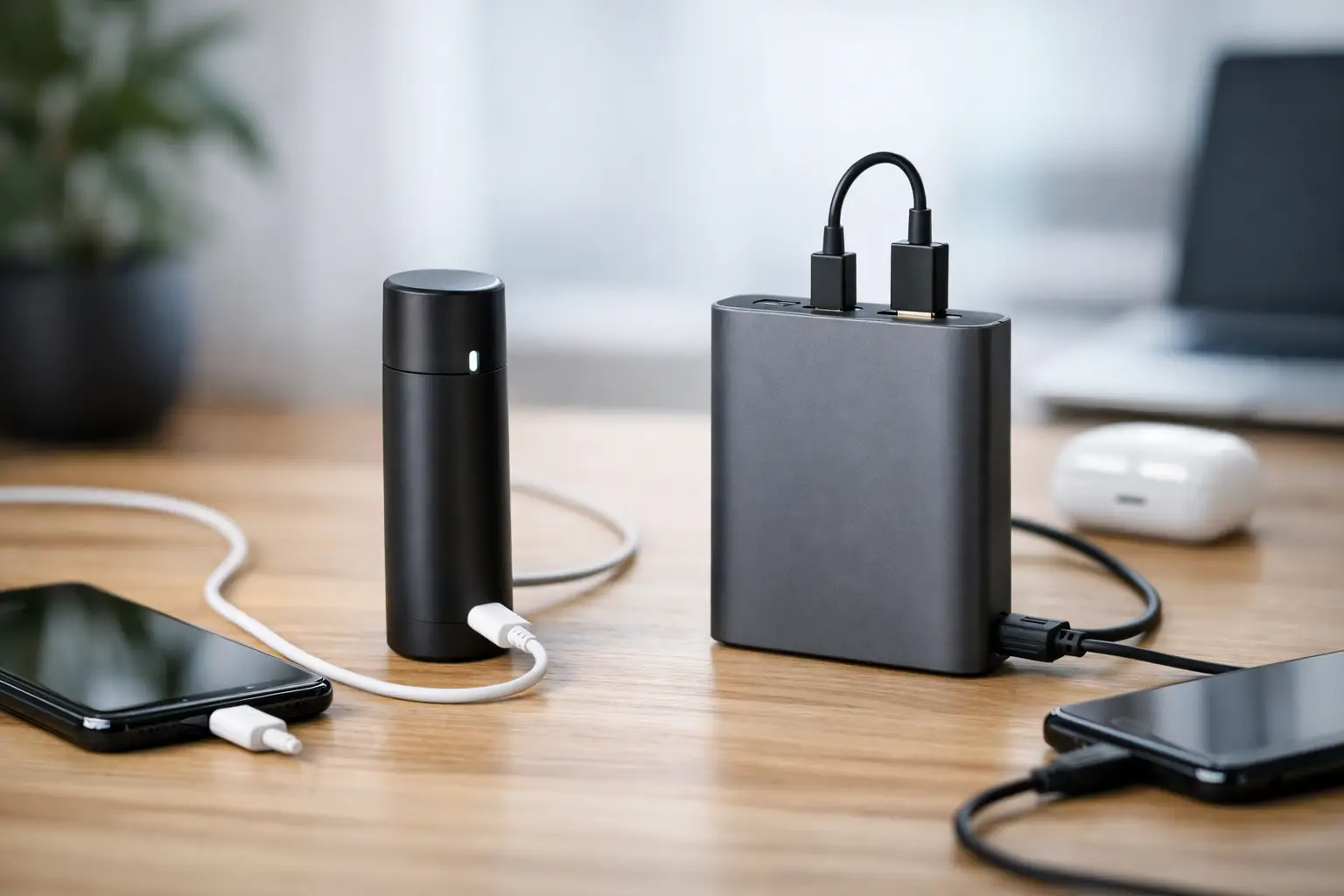
A phone at 8% changes the mood of a commute, a flight, or a day spent capturing family moments. The phrase portable charger vs power bank can make shopping feel more complicated than it needs to be, especially when product names use both terms. The short answer is that they often describe the same useful accessory, but the distinction matters when you want a charging setup that feels considered, capable, and right for your routine.
A power bank is a battery you carry with you. It stores energy in advance, then sends that energy to a phone, tablet, earbuds, smartwatch, or other compatible device when no wall outlet is within reach. A portable charger may mean that same battery pack, but it can also refer to any compact charging device, including a wall adapter, car charger, wireless charging pad, or charging stand.
For shoppers comparing battery packs specifically, the terms are usually interchangeable. For everyone else, the better question is not what the accessory is called. It is whether it delivers the speed, capacity, design, and convenience your lifestyle deserves.
Portable Charger vs Power Bank: The Real Difference
Think of “power bank” as the precise product category. It is a rechargeable external battery with one or more outputs. You charge the power bank before leaving home, then use it to replenish another device later.
“Portable charger” is broader. A slim plug-in wall charger that slips into a weekend bag is portable, but it cannot charge your phone unless it is connected to an outlet. A car charger is portable, too, yet it depends on your vehicle. A power bank is the portable charger that brings its own power source.
That distinction becomes useful when reading product descriptions. If you need freedom from outlets at the airport, on a trail, at a festival, or during a long workday, choose a power bank. If you simply want a more polished, travel-ready way to charge from available outlets, a compact wall charger may be the better buy.
There is also a practical overlap. Many premium power banks now include built-in cables, integrated AC plugs, magnetic wireless charging, or small display screens. These details make a power bank feel like a complete portable charging station rather than a basic battery brick.
Choose by How You Actually Spend Your Day
The ideal capacity is not always the largest one. Bigger power banks hold more energy, but they also add weight, take longer to recharge, and occupy more room in a handbag, briefcase, or carry-on. The most elevated choice is the one you will genuinely want to bring with you.
For daily errands, commutes, and evenings out
A compact 5,000mAh to 10,000mAh power bank is often the sweet spot. It can provide a meaningful phone recharge without turning a small bag into a tech drawer. This size suits commuters, students, concertgoers, and anyone who uses maps, streaming, mobile payments, and social apps throughout the day.
A magnetic wireless model can be especially appealing for compatible phones. It keeps the charging setup clean and cable-free, which is ideal when you are moving between appointments or traveling light. The trade-off is that wireless charging usually creates more heat and can be slower than a quality wired connection. For a quick boost, it is wonderfully convenient. For maximum efficiency, use a cable.
For travel, workdays, and shared devices
A 10,000mAh to 20,000mAh power bank offers more flexibility. It is a smart companion for a full day of travel, a packed conference schedule, or a household outing where more than one person may need power. Look for two or more ports if you expect to charge a phone and earbuds together, or share power without choosing whose battery gets priority.
For professionals, creators, and frequent travelers, USB-C Power Delivery is a feature worth prioritizing. It can charge compatible phones quickly and can support certain tablets and lightweight laptops when the power bank provides enough wattage. Capacity matters, but output matters just as much. A high-capacity bank with a low-output port may last a long time while still charging a demanding device at an underwhelming pace.
For laptops and extended time away from outlets
Power banks in the 20,000mAh range and above are designed for more ambitious needs. They can be an excellent option for a tablet-heavy workflow, remote work sessions, road trips, and longer stretches away from dependable power. They are also more substantial, so check the product dimensions and weight before assuming it belongs in an everyday bag.
If laptop charging is the goal, confirm the required wattage for your particular computer. Many laptops need far more power than a phone, and not every USB-C power bank can provide it. A 65W or higher output may be appropriate for some models, while larger computers may need more. The cable must support the intended wattage as well.
Capacity Numbers Need a Little Context
Milliamp-hours, written as mAh, are helpful for comparing power banks, but they do not translate perfectly into a fixed number of phone charges. Real-world results vary because batteries operate at different voltages, energy is lost during conversion, and devices use power while charging.
As a general expectation, a 10,000mAh power bank can often recharge a modern smartphone around one to two times, depending on the phone and how it is used. A 20,000mAh model can provide considerably more reserve power, but it is not automatically twice as convenient. Your device mix, travel habits, and tolerance for extra weight should guide the choice.
Watt-hours, or Wh, offer another useful reference point, particularly for air travel. Airline rules commonly treat spare lithium-ion batteries as carry-on items rather than checked luggage, and batteries under 100Wh are generally accepted. Policies can vary by airline and destination, so review the requirements before departure. Keeping the capacity label visible and the power bank protected from damage is a sensible travel habit.
The Features That Separate a Fine Choice From a Great One
Elegant design is more than appearance when you use an accessory every day. A slim profile, soft-touch finish, thoughtfully placed ports, and a clear battery indicator make charging feel less like an interruption. Still, the most attractive model should meet a few functional standards.
Fast charging is one of them. Check both the input and output specifications. Output tells you how quickly the power bank can charge your devices. Input tells you how quickly the bank itself can recharge. A large battery pack that takes all night to refill can be frustrating before an early departure.
Port selection is another consideration. USB-C is increasingly essential because it can handle both fast charging and, on many models, charging the power bank itself. USB-A remains useful for older cables and accessories. Built-in cables reduce what you need to pack, although a separate cable is easier to replace if it wears out.
Safety should never be treated as a luxury feature. Choose models with protections against overheating, overcharging, short circuits, and excessive current. Reputable construction, dependable battery cells, and a well-fitted exterior are especially valuable if the accessory will live in a tote bag beside keys, cosmetics, or other daily essentials.
When a Portable Wall Charger Is the Smarter Purchase
A power bank is not always the answer. If you spend most of your time near outlets, a small high-wattage wall charger may deliver more value. It can charge your phone, tablet, and compatible laptop quickly without requiring you to remember another battery level.
This is especially true for hotel stays, office days, and home setups where outlets are available but bulky charging blocks are not welcome. A refined compact wall charger paired with a quality USB-C cable keeps your travel kit lean while still giving you dependable power.
For many people, the best arrangement is both: a fast wall charger for starting the day and recharging overnight, plus a slim power bank for the hours when an outlet is unavailable. It is a small upgrade that protects your schedule, your connectivity, and the moments you do not want to miss.
A More Considered Way to Buy
Before choosing, picture the exact moment you will need it. Is it a low-battery phone halfway through a shopping day? A tablet keeping a child entertained on a flight? A laptop that needs a final hour of power before a presentation? The answer points naturally toward the right capacity, output, and form factor.
Bluurban’s approach to elevated everyday essentials is rooted in that kind of practical refinement: choosing products that look at home in your routine while quietly making it run better. A well-chosen power bank is not just backup battery life. It is the confidence to stay present, productive, and ready for whatever the day adds to your plans.













Leave a comment